 Moed
Moed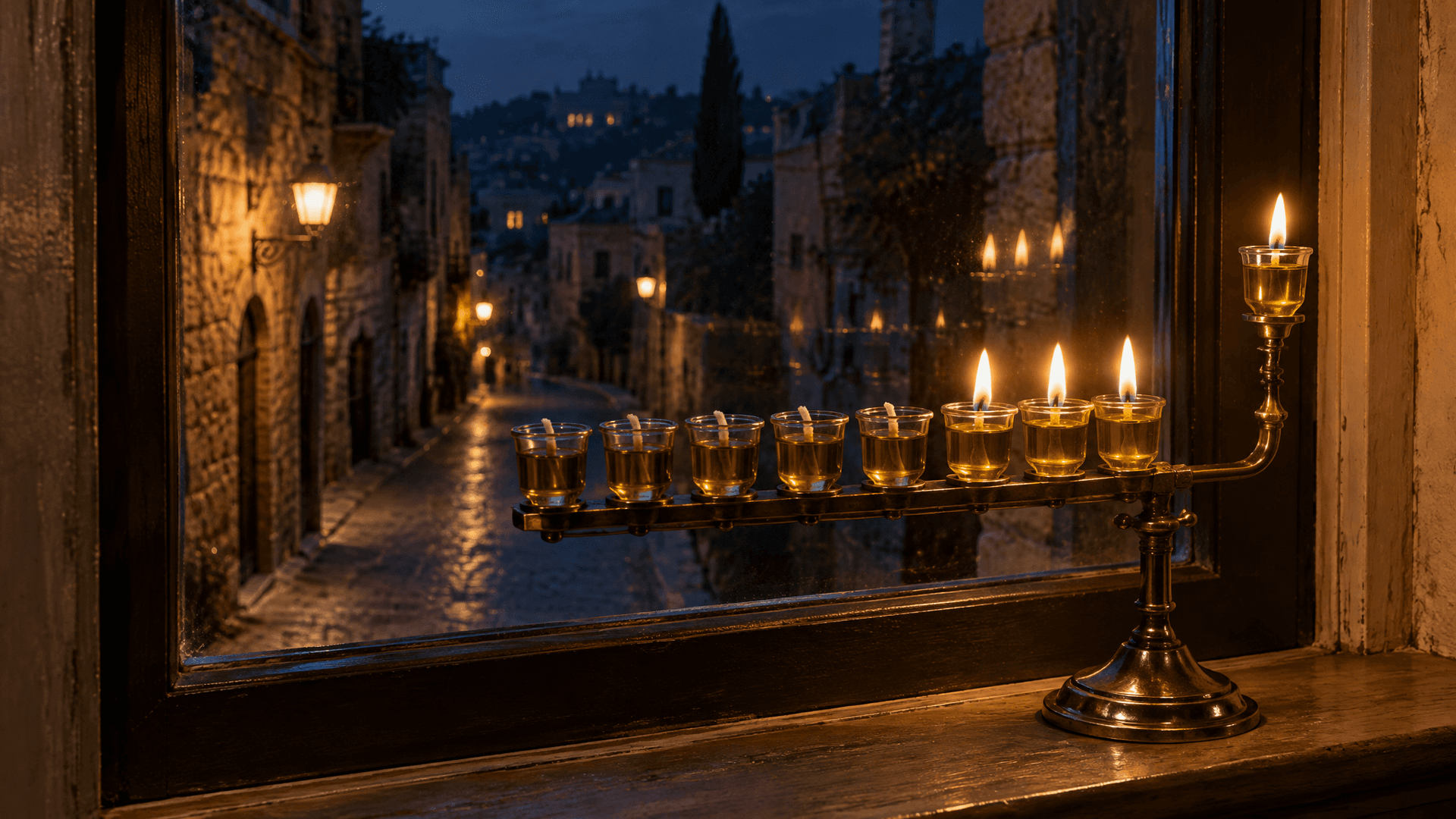
The principle: one light a night, then one more
According to the Talmud, the basic commandment is for the head of the household to have one light kindled each night, for himself and his family. Those who are more careful, the mehadrin, light one for each person in the home. Others, more scrupulous still, vary the number each day, and there Beit Shammai and Beit Hillel differ: Beit Shammai count down from eight to one, Beit Hillel add one light each night, from one to eight (Shabbat 21b). Practice follows Beit Hillel: one light on the first night, then one more each night, up to eight on the last. Even when the household is large, the Shulchan Arukh does not go beyond that number (Orach Chaim 671:2).
The Rema adds the widespread custom that each member of the household lights their own menorah. In that case he asks that each place theirs in a separate spot, so that the number of lights can be counted (671:2). Women are bound by the commandment like men (675:3), and the Rema wants a child old enough to be educated in the mitzvot to light as well.
| Night | Date in 2026 | Lights |
|---|---|---|
| 1 | Friday, December 4 | 1 |
| 2 | Saturday, December 5 (after Shabbat ends) | 2 |
| 3 | Sunday, December 6 | 3 |
| 4 | Monday, December 7 | 4 |
| 5 | Tuesday, December 8 | 5 |
| 6 | Wednesday, December 9 | 6 |
| 7 | Thursday, December 10 | 7 |
| 8 | Friday, December 11 | 8 |
Each date is the evening you light: the eve of the Jewish day. The times for your city are on the Hanukkah 2026 page.
What to prepare
The Shulchan Arukh accepts any oil and any wick (Orach Chaim 673:1). The Rema notes that olive oil is the finest way to fulfil the commandment; failing that, an oil with a pure, clear flame. In the countries where he wrote, the custom is to light wax candles, whose flame is as clear as oil's.
Two more points from the same source:
- An ordinary earthenware vessel used for one night has become "old" and is not used again; metal, glass and glazed earthenware can be reused (673:3).
- The lights are set in a straight row, not in a circle, which would look like a bonfire (671:4). A menorah with eight branches in a line meets this rule.
The shamash is an extra light used to kindle the others. The Rema explains that it is lit in addition because it is forbidden to benefit from the Hanukkah lights; if you use any light, it will be this one. In the countries where he wrote, no separate light is added: the shamash alone is enough, and it is made longer than the others so that people will use it instead (673:1). Many menorahs place it on a higher branch.
Where to put it
The light goes at the entrance that opens onto the public way, on the outside. For someone living upstairs with no entrance onto the street, it goes at a window facing the public way (671:5). It is set more than three handbreadths off the ground and preferably below ten; above twenty cubits the commandment is not fulfilled (671:6). The Shulchan Arukh wants it on the left of the door, so that the mezuzah is on the right and the menorah on the left (671:7).
Today most people light indoors. The Rema writes that in that case one need not worry as much about the distance from the door, but the custom remains to set it near the entrance, and not where you light every day of the year: at least some sign must set Hanukkah apart. The usual choice is therefore a window, or a table near the entrance, seen from the street or from the room where you live. Settle the details with your rabbi, especially in an apartment building.
When to light
The Shulchan Arukh sets the time of lighting at the end of sunset, neither before nor after; it also records an opinion allowing someone who is busy to light from plag hamincha, with enough oil to last until passers-by thin out (Orach Chaim 672:1). The Talmud measures the end of this window by the point where traffic in the marketplace stops (Shabbat 21b), about half an hour.
Someone who did not light in time, through forgetfulness or on purpose, lights until that half hour is over. The Rema considers that today, when people light at home, it is no longer essential to keep to that window, but that it is still good to do so. After it has passed, one may still light during the night; once the whole night has gone by without lighting, it cannot be made up (672:2). Communities do not all follow the same moment, between sunset and the appearance of the stars: ask your own community's custom. Sunset in your city is on the Shabbat times page.
In what order to light
On the first night you light the single light, at the right. On the second night you add a light to its left: that is the one you light first, then you move to the right. Every following night you add the new light on the left and light the newest one first, then move to the right: the added light recalls that the miracle grew each day (Orach Chaim 676:5). On the last night you therefore light from the eighth light, at the far left, to the first, at the far right.
Concretely, on the third night: fill the three cups on the right, light the shamash, say the blessings, then light the leftmost of the three, then the next two moving right.
The blessings
On the first night you say three blessings: lehadlik ner shel Hanukkah (to light the Hanukkah light), she'asa nissim la'avotenu (who performed miracles for our ancestors) and shehecheyanu (who has kept us alive to this time). On the following nights, only the first two (Orach Chaim 676:1 and 676:2). Someone who forgot shehecheyanu on the first night may say it on another night, as soon as they remember. According to the Rema, the blessings are said before you begin to light.
After lighting, you recite Haneirot halalu ("These lights we kindle for the salvations, the miracles and the wonders…", 676:4). The full text of the blessings and of this passage is in a prayer book or your community's ritual.
When Hanukkah falls on a Friday
In 2026 the first night is a Friday, and so is the eighth. On Friday you light the menorah first, then the Shabbat candles: you say the blessings as on a weekday, even though you are lighting while it is still broad daylight (Orach Chaim 679:1, with the Rema's gloss). In New York, by Moed's calculation, Shabbat candles are lit at 4:10 PM on both Friday, December 4 and Friday, December 11, so the menorah is lit before that time. How long the menorah must burn that evening, before and into Shabbat, is a question for your rabbi.
On Saturday night you light the menorah after Shabbat ends, before the night is over: in New York, by Moed, Shabbat ends at 5:14 PM on Saturday, December 5. For that calculation, see When Does Shabbat End? 8.5° or Rabbeinu Tam.
When you are away from home
The Shulchan Arukh says that someone in a place with no other Jews lights with the blessings, even if someone lights for him at home (Orach Chaim 677:3). Where to light in a hotel or a residence is a question for your rabbi; the time to follow is that of the place where you are.
Each situation depends on the exact time, the place and your community's custom. For a halakhic ruling, consult your rabbi.