 Moed
MoedThe calculation rules
| Rule | Value |
|---|---|
| Altitude | None: everything at sea level (sunrise, sunset, proportional hours, candle lighting). Jerusalem calendars, Hebcal and most luchot count this way. |
| Shabbat candle lighting | Sunset minus the minutes of the city’s custom, rounded to the earlier minute. |
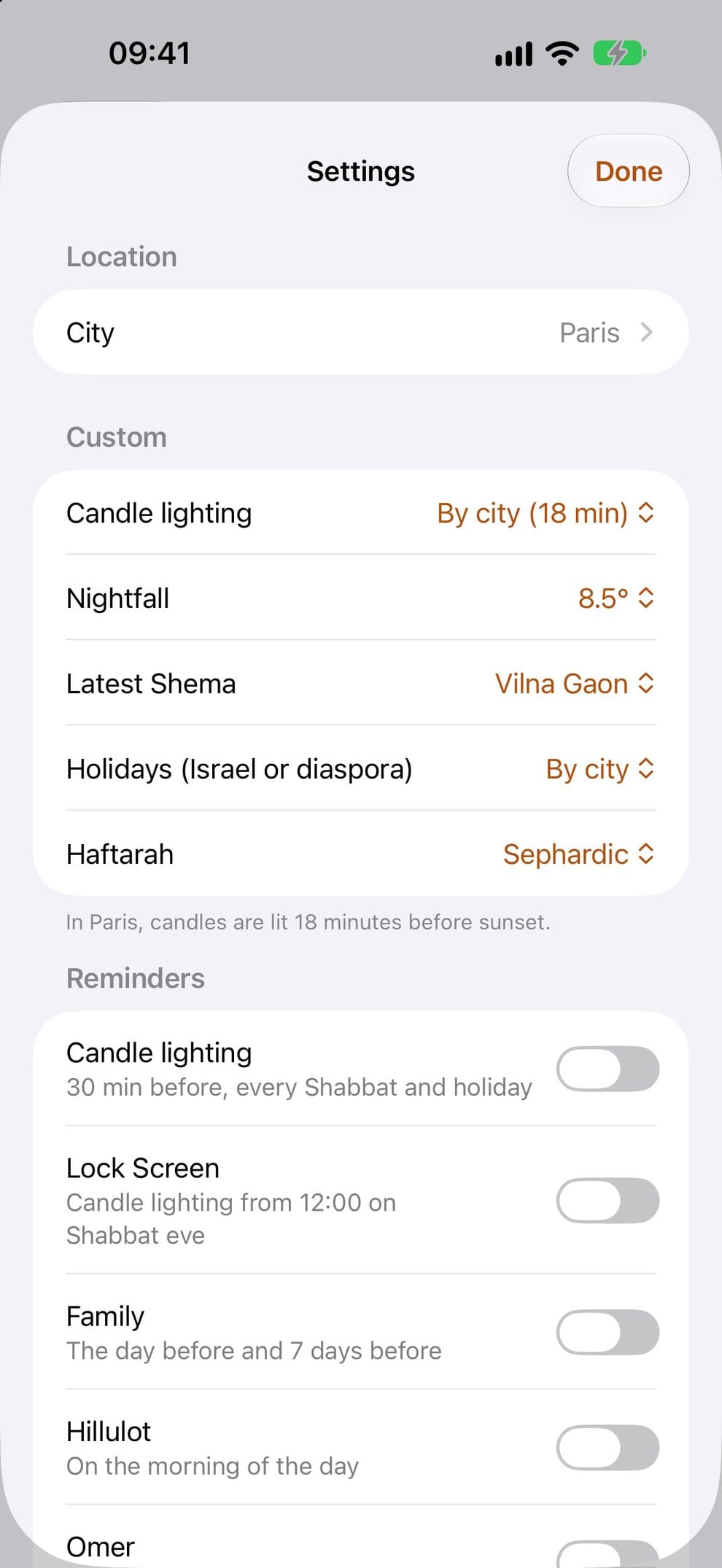
| Lighting minutes | 18 minutes in the diaspora; in Israel 20 by default, 40 in Jerusalem, 30 in Haifa, Petah Tikva and Beer Sheva. |
| Second night of a holiday, holiday after Shabbat | Lighting after nightfall (8.5°), from an existing flame, rounded to the later minute. |
| Havdalah and end of a holiday | Sun 8.5° below the horizon, rounded to the later minute. Rabbeinu Tam: sunset plus 72 minutes. |
| Minor fast | From dawn (16.1°) to nightfall (8.5°). On a Friday there is no end time. |
| 25-hour fast (Yom Kippur, Tisha B’Av) | From sunset the evening before to nightfall. |
| Hanukkah | On Friday, before the Shabbat candles; on Saturday, after Havdalah; on weekdays, from sunset or from nightfall according to custom. |
| Hebrew date right now | Changes at the minute of the sunset shown. |
| Israel | One day fewer for some holidays, the Israeli Torah portion: the Hebrew page follows the Israeli calendar. |
An example, with the calculation detail · New York: sunset 6:14 PM, minus 18 minutes: candle lighting at 5:56 PM; Havdalah at 6:54 PM.
Rounding, always to the cautious side
What closes a permission or starts a prohibition is rounded down to the minute; what opens a permission or ends a prohibition, up. The same time may therefore round differently depending on its role.
| Down (earlier) | Up (later) |
|---|---|
| Shabbat and holiday candle lighting | Dawn, misheyakir, sunrise |
| End of Shema (Vilna Gaon, Magen Avraham) | Mincha gedola, mincha ketana, plag hamincha |
| End of Tefilah, chatzot, sunset | Tzeit (nightfall) |
| Start of a fast | Havdalah and end of a holiday, Rabbeinu Tam, end of a fast |
The candle-lighting custom of each city
Each city’s custom comes from the Moed app’s table (reviewed October 6, 2026). A city in Israel whose custom has not yet been reviewed shows its minutes as a “default setting”, never as the city’s established custom: ask your community.
On every city page the custom can be changed: if your community lights 20 or 30 minutes before sunset, the time shown follows.
Comparison with Hebcal
Moed is compared with Hebcal’s public API at every change to the engine (twelve cities, six Fridays from October 2026 to June 2027, 313 holiday dates from 2020 to 2032). Holiday dates and the Torah portion of every Shabbat are identical.
Times can differ by a minute: Hebcal rounds to the nearest minute, Moed to the cautious side. A Havdalah may therefore show a minute earlier at Hebcal (19:44 against 19:45 in Paris on October 17, 2026). This is deliberate.
Two deliberate gaps: the end of fasts (Hebcal takes 7.083°, Moed 8.5° like the app, hence later) and weekday Hanukkah lights (Hebcal: bein hashmashot; Moed: from sunset and from nightfall).
| Compared | Count | Same minute | One minute, cautious side |
|---|---|---|---|
| Shabbat candle lighting | 72 | 71 | 1 |
| Havdalah (8.5°) | 72 | 32 | 40 |
| Zmanim (15 per day) | 1,078 | 546 | 532 |
| Start of fasts | 70 | 39 | 31 |
Test of October 13, 2026: twelve cities including Paris, London, New York, Jerusalem and Tel Aviv.
Sources
- KosherZmanim (NOAA algorithm) · solar calculation
- Hebcal · dates, portions, comparison
- GeoNames · coordinates and time zones, CC BY 4.0 license
- Sefaria · texts cited
Found a mistake?
If a time looks wrong, tell us the city, the date and the time you expected: from the app’s page on the App Store, under “Support”. We check every report.
For a halakhic ruling, ask your rabbi.
These times on your iPhone
The same calculation rules in the app: your custom, your times, a reminder every Friday.

Free, with no ads and no in-app purchases.
Your data stays on your phone.