 Moed
Moed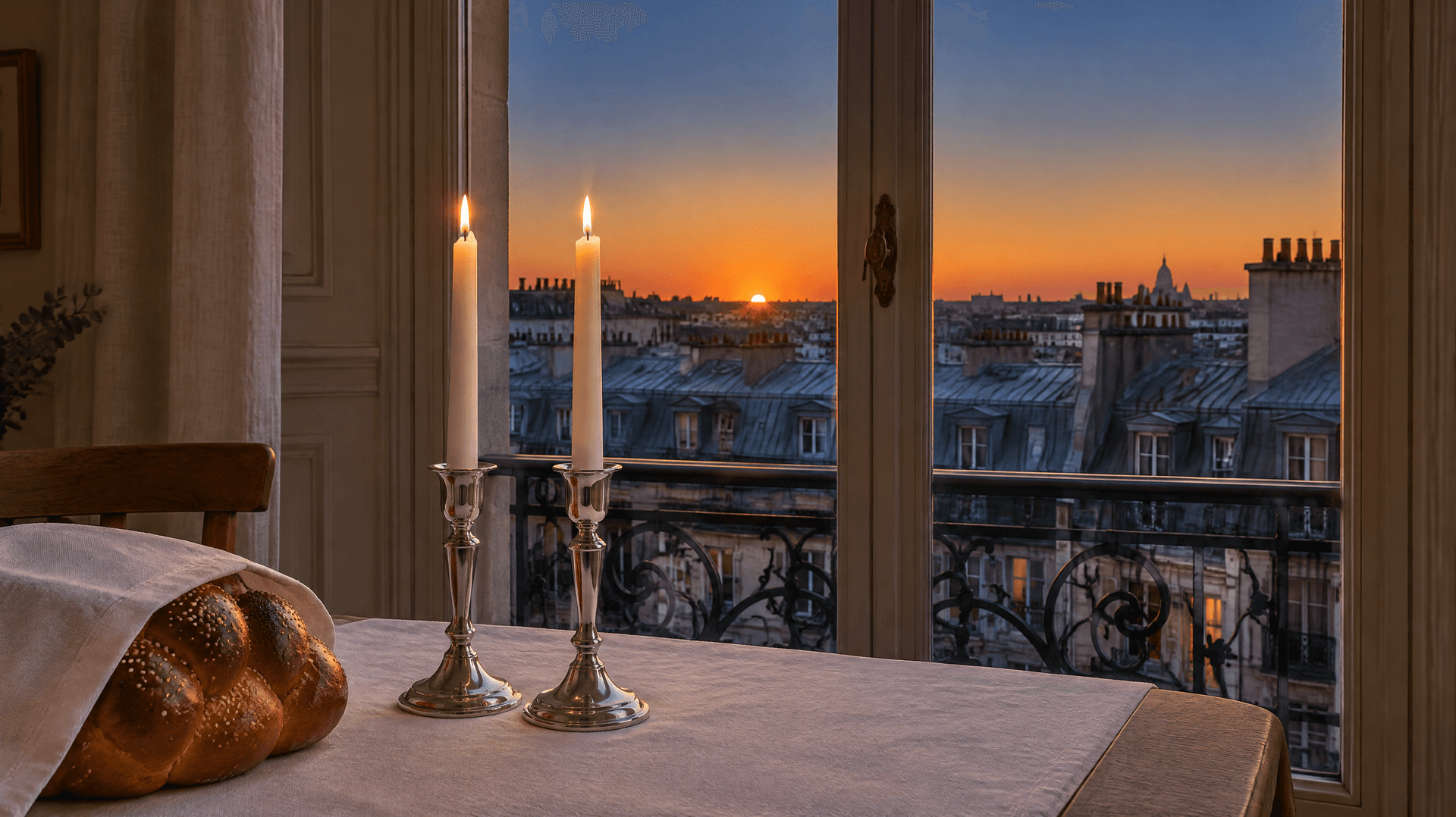
Shabbat begins at sunset
In the Jewish calendar the day starts in the evening: "and there was evening and there was morning" (Genesis 1:5). So Shabbat begins on Friday, and the moment that matters is sunset, the shkiah.
Sunset is not a clean line. Right after it comes bein hashmashot, "between the suns", a stretch of time when it is doubtful whether it is still Friday or already Shabbat. The Mishnah lists lighting the lamp among the things one no longer does once that doubt has begun (Mishnah Shabbat 2:7). The Talmud measures the doubt as the time it takes to walk three quarters of a mil (Shabbat 34b) and places nightfall at the appearance of three stars (Shabbat 35b).
On top of that there is an obligation of its own: to take a little time from Friday and add it to Shabbat. This is tosefet Shabbat (Shulchan Aruch, Orach Chaim 261:2). The Mishnah Berurah counts it as a Torah commandment, which the Talmud derives from a verse about Yom Kippur (Rosh Hashanah 9a), and which applies when Shabbat ends as well as when it begins (Mishnah Berurah 261:19). That is why candles are not lit at sunset, but before it.
One sunset or two?
In 261:2 the Shulchan Aruch follows the approach of Rabbeinu Tam, for whom there are two sunsets, so that the doubtful period begins well after the sun has disappeared (Tosafot on Shabbat 35a). The Mishnah Berurah points out that many Rishonim, and the Vilna Gaon, start bein hashmashot as soon as the sun is out of sight, and draws the practical conclusion: finish lighting before sunset (Mishnah Berurah 261:23). Published candle lighting times, Moed's included, count from that visible sunset.
Why 18 minutes?
The Shulchan Aruch gives no number of minutes for candle lighting. The Mishnah Berurah only notes that the added time and bein hashmashot together come to almost half an hour (Mishnah Berurah 261:22). How long before sunset a community lights is a matter of local custom.
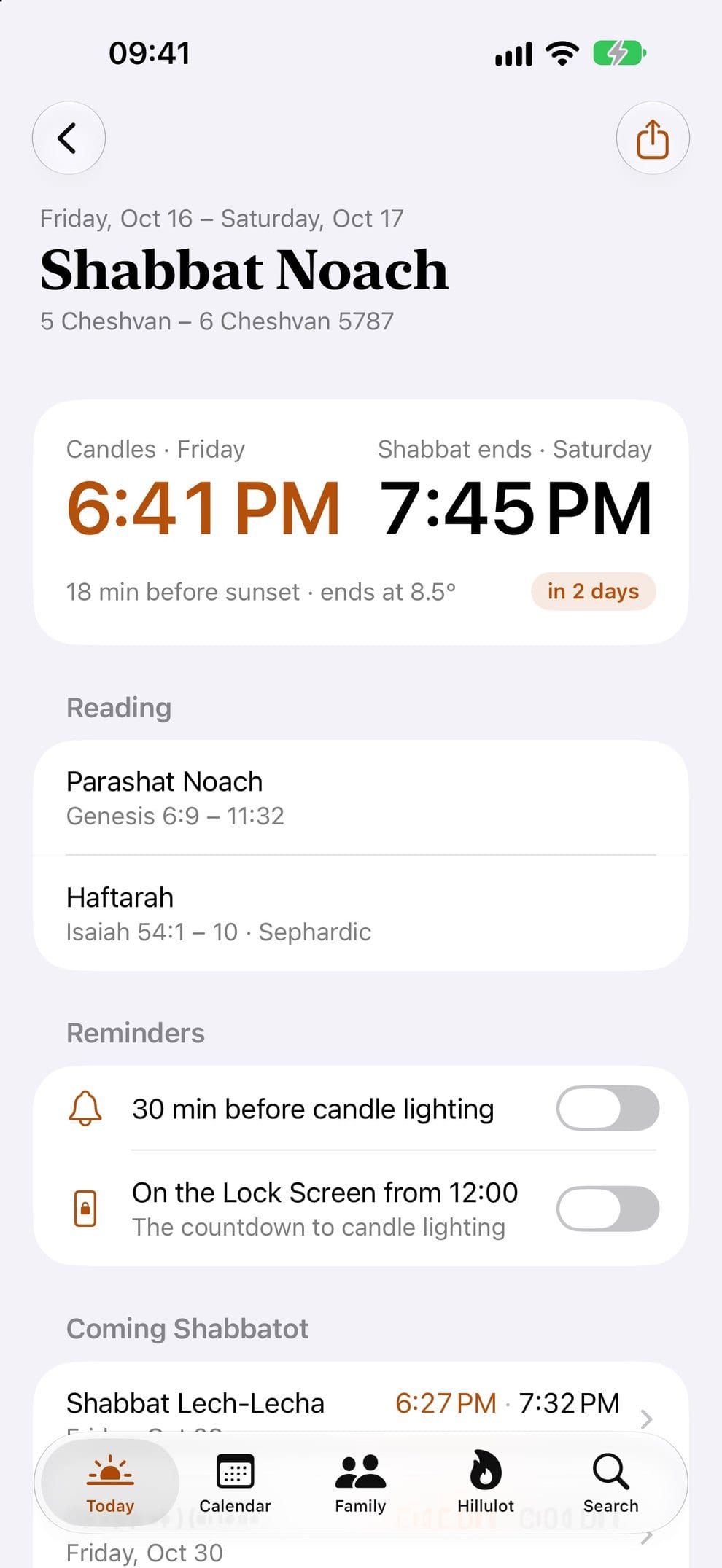
The explanation most often given for 18 minutes goes through the mil, the Talmud's unit of walking time. A gloss in the Shulchan Aruch puts it at "a third of an hour less a thirtieth", which is 18 minutes (Orach Chaim 261:1; the same measure appears in 459:2). It is a common explanation, not a text that sets the number. Other places have their own custom:
| Place | Lighting before sunset | What the number is |
|---|---|---|
| United States, Canada, United Kingdom, France, most communities outside Israel | 18 min | the most widespread custom |
| Jerusalem | 40 min | the city's custom |
| Haifa | 30 min | the city's custom |
| Other cities in Israel | 20 min | Moed's and Hebcal's default setting (Moed uses 30 for Petah Tikva and Beer Sheva) |
Hebcal uses the same defaults: 18 minutes, 40 in Jerusalem, 30 in Haifa (Hebcal help). In Moed the custom can be set for each city: if your community lights 20 or 30 minutes before sunset, the time shown follows that setting. In Israeli cities other than Jerusalem and Haifa, the 20 minutes are a default setting, not an established local custom: ask your community.
Why the time changes every Friday
The number of minutes is fixed; sunset is not. It depends on the date and on the latitude of the city. In New York, candle lighting falls at 4:10 PM on Friday, December 4, 2026, the earliest of the year, and at 8:13 PM on Friday, June 25, 2027, the latest: four hours apart.
| Friday, New York | Sunset | Candle lighting (18 min before) |
|---|---|---|
| October 16, 2026 | 6:14 PM | 5:56 PM |
| December 4, 2026 | 4:28 PM | 4:10 PM |
| March 19, 2027 | 7:06 PM | 6:48 PM |
| June 25, 2027 | 8:31 PM | 8:13 PM |
Twice a year the clock change adds a jump. Daylight saving time ends on November 1, 2026, and candle lighting moves from 5:36 PM on October 30 to 4:28 PM on November 6. It starts again on March 14, 2027: from 5:41 PM on March 12 to 6:48 PM on March 19.
The further north the city, the wider the gap between winter and summer. In London, over the same year, candle lighting runs from 3:33 PM to 9:03 PM. Every Friday of the year is in the table All Shabbat times in New York, ready to print or to add to your calendar.
What Moed calculates
- Sunset, with the NOAA astronomical algorithm (the KosherZmanim library), from the city's coordinates and time zone.
- At sea level, like Hebcal and most calendars: elevation is left out of the calculation. Corrected for its 754 meters of elevation, Jerusalem's candle lighting would come about 4 minutes later, which is the less cautious direction.
- Cautious rounding: candle lighting is always rounded down to the minute, the end of Shabbat always rounded up. Hebcal rounds to the nearest minute, which explains a one-minute difference with it.
- The city's custom, which you can change.
The formulas are set out on the Method and sources page. This Friday's time for your city is on the Shabbat times page.
The lighting itself
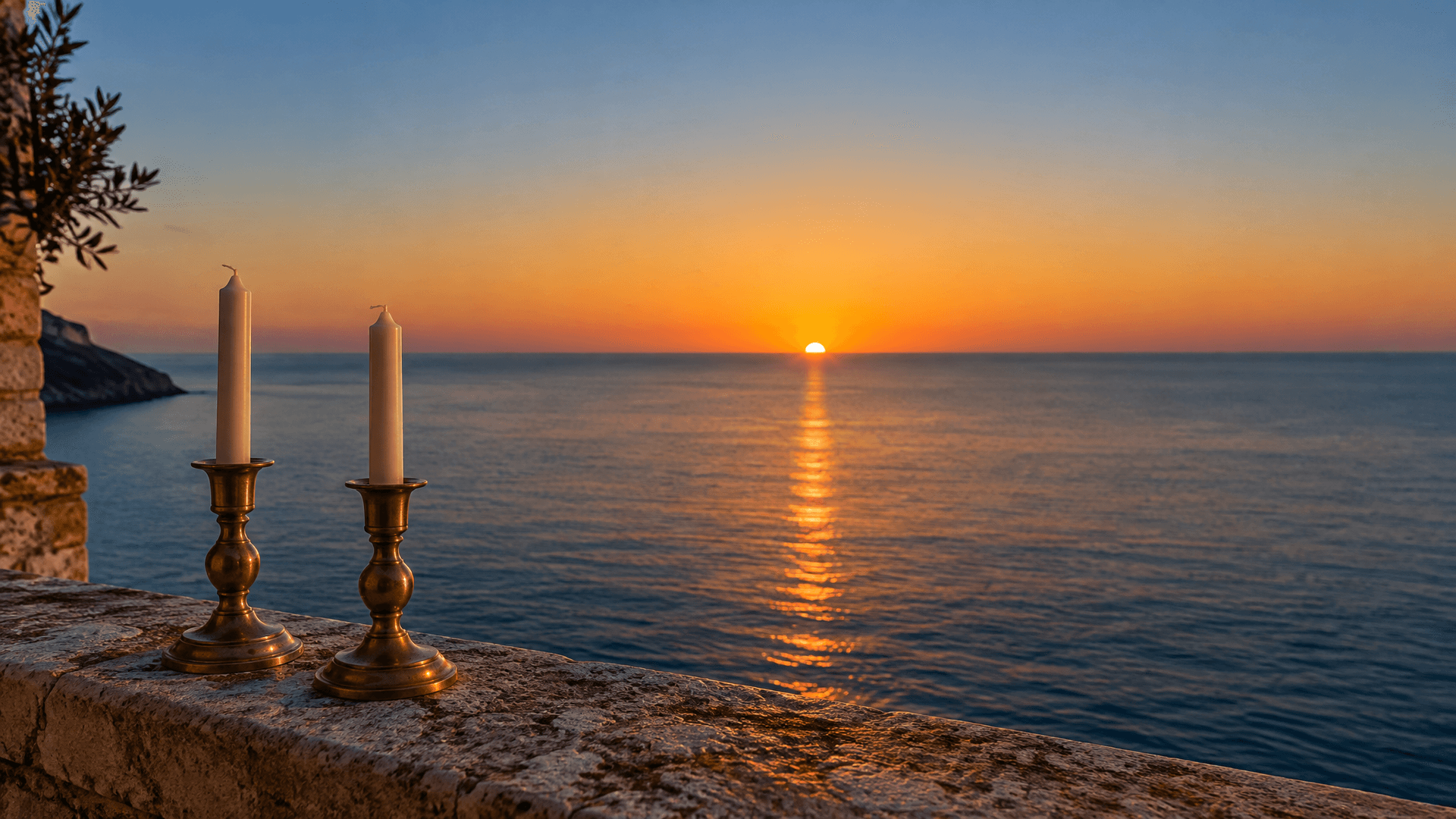
At least two candles are lit, one for "remember" (zachor) and one for "keep" (shamor); the Rema adds that one may light three or four, and that this is the custom (Orach Chaim 263:1). Men and women alike must have a light burning in their home on Shabbat (263:2), and women are especially charged with it, since the home is most often in their care (263:3).
The Shulchan Aruch has the blessing said as one lights. The custom recorded by the Rema is to light first, cover the flames with one's hands, say the blessing, then uncover them (Rema, 263:5). Also according to the custom the Rema records, the woman who lights accepts Shabbat with that lighting (Rema, 263:10): once the candles are lit, she no longer does work forbidden on Shabbat.
What if you did not light in time?
After sunset one no longer lights oneself: the doubt of bein hashmashot has begun (Mishnah Shabbat 2:7). During that doubtful time, the Shulchan Aruch only allows asking a non-Jew to light for the needs of Shabbat (Orach Chaim 261:1). Those who reckon by Rabbeinu Tam have a little more margin, and the authorities discuss how far one may rely on it (261:2 and Mishnah Berurah 261:23).
A woman who once forgot to light lights three candles from then on, for the rest of her life (Rema, 263:1). The Mishnah Berurah explains: if she already lit three, she lights four; each further lapse adds a candle; and nothing is added if she was prevented by circumstances beyond her control (Mishnah Berurah 263:7).
Each case depends on the exact time and the circumstances. For a halakhic ruling, consult your rabbi.
And when does Shabbat end?
Shabbat ends on Saturday night, when three small stars close together can be seen (Orach Chaim 293:2). Moed places that moment when the sun is 8.5° below the horizon, as Hebcal does: 6:54 PM in New York on Saturday, October 17, 2026. Those who follow Rabbeinu Tam wait 72 minutes after sunset, which is 7:25 PM that evening. Both methods are explained in When Does Shabbat End? 8.5° or Rabbeinu Tam.